Taking Park City’s Zero Waste Event Lessons to Mountain Towns 2030
In October, Park City Community Foundation’s Climate Fund Manager, Victoria Schlaepfer, had the chance to present the Zero Waste Event Resource Guide at the Mountain Towns 2030 Climate Summit in Sun Valley, Idaho, alongside Morgan Mingle, the Senior Director of Sustainability for the Park City Chamber & Visitors Bureau. Victoria was excited to share how Park City and Summit County are making events less wasteful, and what other mountain towns can borrow from that experience.
For Victoria and the Community Foundation, this work sits at the heart of Zero Food Waste, the Community Foundation’s initiative launched in 2024 with one clear goal: eliminating and diverting all food waste from the Summit County landfill by 2030. Events are one of the most visible places to make progress, and one of the best places to show the community what’s possible.
Events are where residents, part-time residents and visitors all see a town’s waste up close. The Community Foundation focused on them for three reasons: visibility, reach, and the chance to build a solution that works locally.
In Summit County’s 2019 waste characterization study, organics made up about 39% of the waste going to the landfill. In Park City’s 2021 Main Street study, organics were about two-thirds of restaurant and bar waste. Much of what the community throws away could feed people or be composted instead, and with the local landfill projected to fill by 2053, every pound diverted matters.
Four takeaways for any mountain town to implement Zero Waste Events
- Keep guidance to event organizers short and ranked. The first draft was thorough but dense, and busy organizers won’t read a long report. The team rewrote it as a step-by-step checklist ranked from most to least impactful, starting with “get to know your waste.” The top moves are water refill stations, reusable serviceware from your caterer, consumable or donation-based giveaways, and ordering food based on expected attendance. That last one is food waste prevention at its simplest.
- Build it with partners, not around them. The guide came together with input from Deer Valley Resort, Park City Municipal, Summit County, and Recycle Utah. Because partners helped shape it, the guide supports work already underway instead of competing with it.
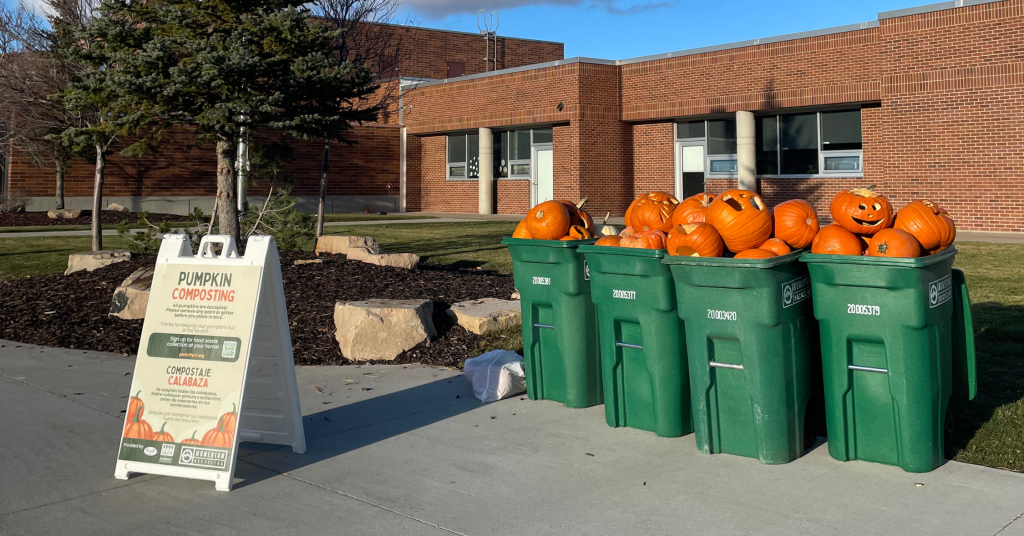
- Staffed stations make the difference. A row of bins doesn’t sort itself. People standing at the bins, helping attendees choose the right one, is what moved the numbers.
- Work upstream with vendors. Most sorting headaches start with what vendors hand out. Agreeing on cups, utensils and service ware before the event beats digging through bags the next day.
Putting the guide to the test at the Oakley Rodeo BBQ
Victoria and Morgan didn’t want to hand organizers a guide they hadn’t used themselves. So they staffed the waste stations at the Oakley Rodeo BBQ, an annual pop-up event with about 300 attendees and no on-site waste management.
With two staffed stations, the event produced 114.26 pounds of waste. The team kept 78.1 pounds out of the landfill, about two-thirds of it being food scraps, for a 68.4% diversion rate. That’s roughly double the 32% national average. Weighing everything also gave the team a clear number to beat next time.
What the Community Foundation learned from other mountain towns
For Victoria, one of the best parts of presenting at the summit was hearing from peers. The biggest lesson: Park City and Summit County are not unique. The waste sorting challenges our area faces at events show up in mountain towns well beyond Summit County.
Two challenges came up repeatedly:
- Staffing waste stations. Nearly every town is looking for the people and resources to staff bins at events, and they’ve seen the same thing the Community Foundation has: unstaffed stations don’t sort well.
- Upstream sourcing. Getting vendors and organizers to choose better materials before the event is still hard everywhere.
These conversations were a reminder that no town has to solve this alone. If you’re working on event waste in your own community, Park City Community Foundation would love to compare notes. To connect, reach out to Climate Fund Manager, Victoria Schlaepfer, at victoria@parkcitycf.org.